
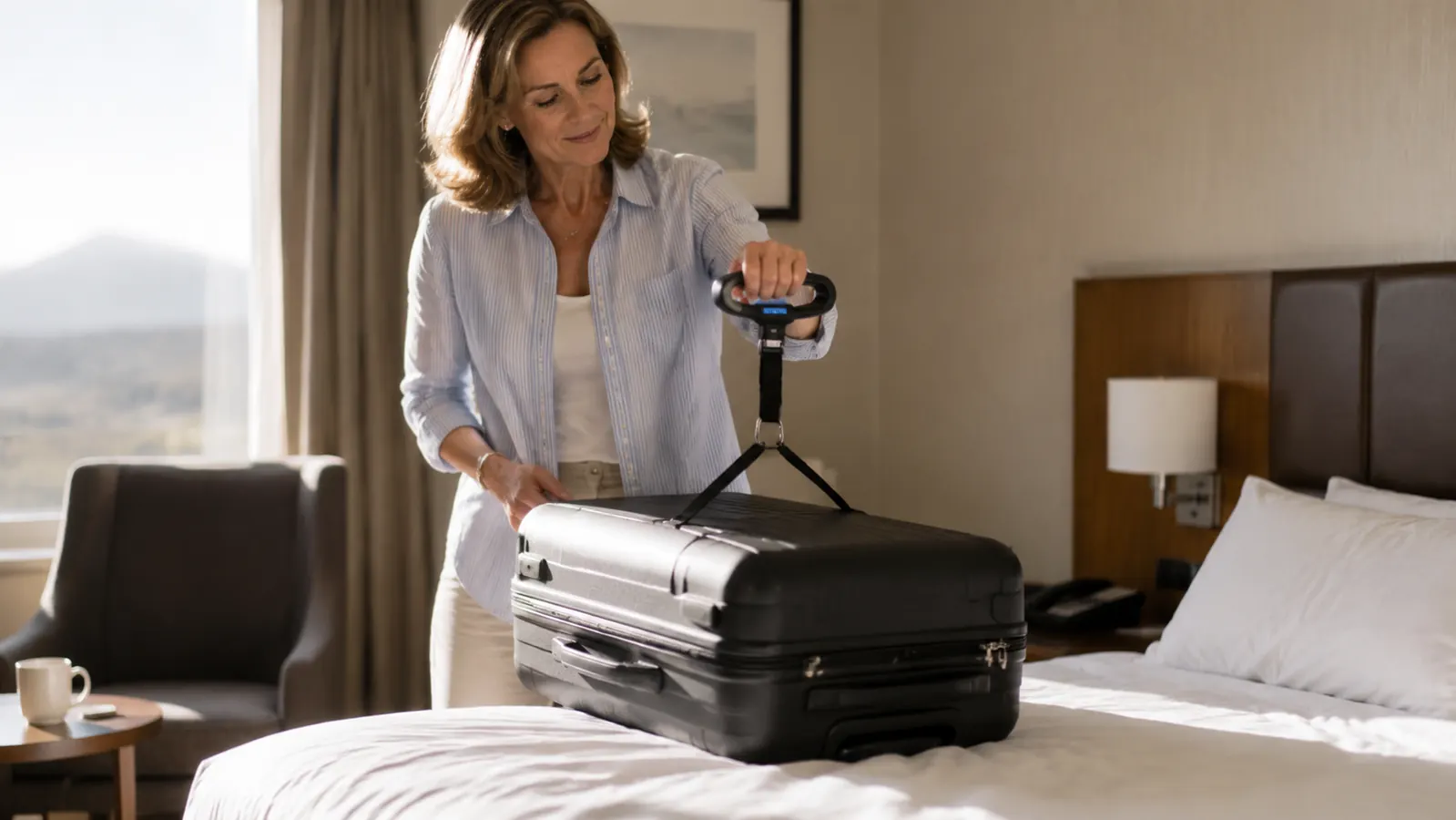
Nothing takes the shine off a trip faster than the check-in counter, when the agent lifts my suitcase onto the belt and says two words I have grown to hate: heavy, and then a number. For years I told myself I packed light, and then I stood there while the scale read out three pounds over, paid the fee, and spent the first night of the visit doing frustrated folding for the flight home. The worst one was outbound to my mother for two weeks, where I paid an overweight charge on the way out and quietly arranged my things into the for a lighter bag on the way back.
The whole problem is that my hand is a terrible scale. I guess my bag by how full it looks, and how full it looks has nothing to do with how heavy it is. So I stopped guessing. A small digital luggage scale, the Etekcity wrote the end of that story for me, because it settles the one argument I kept losing with the airport. What follows is the exact five-step routine I run before and after every flight, the one that means nobody at check-in ever tells me my weight again.
The scale that ends the check-in surprise
Every step in this guide depends on one thing, knowing your real weight before you leave the door. The Etekcity luggage scale reads up to a heavy weight, shows it on a clear digital display, and fits flat in the side pocket of a bag. It has more than enough reviews to be trusted, and it is the whole reason my baggage dread is gone.
Amazon Check Today's Price on Amazon →Step 1: Weigh the empty bag and write the number down
Here is the step almost nobody does, and it is the one that makes the math honest. Weigh your suitcase on the Etekcity scale when it is empty, before a single fold goes in. Hook the handle through the strap, lift it so the whole bag clears the floor without your hand touching it, and read the display. Write that number in a note on your phone, because it is the baseline for every calculation to come and you will forget it the way you forget last year's mileage.
The reason this matters is that the airlines quote you a checked limit, say fifty pounds, but that limit is for the whole loaded bag. If the bag itself weighs ten of those fifty, you only have forty left for clothing, shoes, and everything else. I used to think, generously, that I could take what filled the bag, which is how I landed at fifty-three pounds. Knowing the empty weight turns a vague allowance into an actual number I can aim at.
Do this again if you ever buy a second bag. A hard case and a soft duffel carry a very different dead weight, and assuming they are the same is exactly the kind of guess that costs you a fee at the first counter of a long trip. Ten seconds with the scale sets the true starting line, and the rest of the routine builds on it.
Step 2: Pack to a weight limit, not to how full the bag looks
Now comes the habit that saves the most money. Decide the target before you fill, so the target is a number and not a hope. Take the airline allowance, subtract what you already know the empty bag weighs, and subtract another two hard pounds as a safety margin, because check-in scales never read the same as home. That number is now the most you are allowed to put in. It feels oddly dictatorial at first, and it is exactly what saves you.
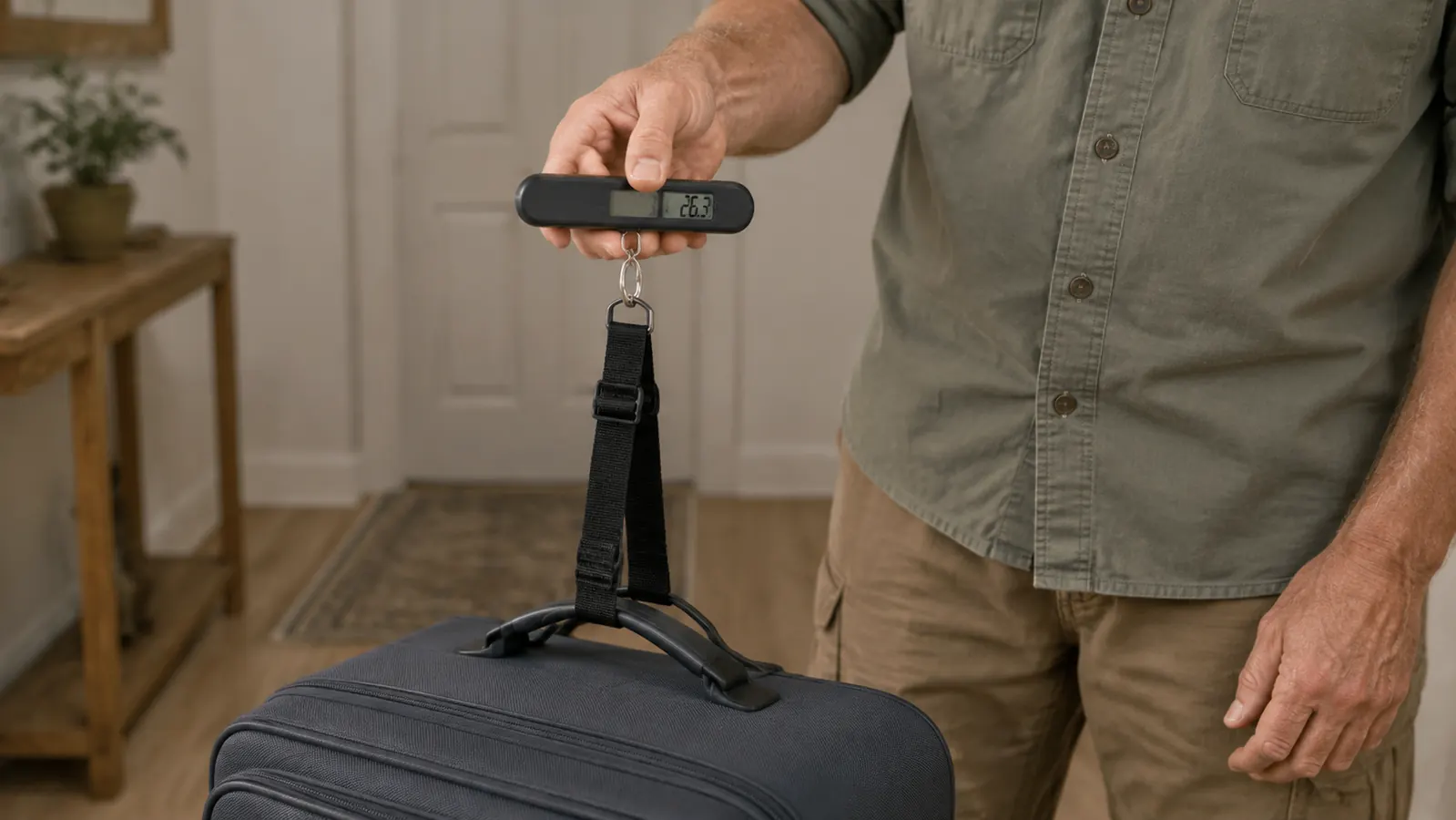
When the bag is full and heavy, the scale settles it in seconds. One lift, the strap through the loop, the whole bag off the floor, done. A digital luggage scale like the Etekcity reads in whole pounds and even in tenths on mine, so a bag that used to be a shrug is now a concrete, unarguable figure. When it reads four pounds, over no, it reads fine, I close it and move on. When it reads close, I know before I ever get to the airport, which is the entire point.
The honest catch with any luggage scale is that you have to want the answer. It is tempting to skip this at two in the flip of a late packing night because knowing feels like a risk. But the fee you avoid, the one you would have discovered at the counter, is almost always larger than the cost of four nights of eating out, and the only friend in the room is the scale that will not flatter you.
Step 3: Lift it square and let it settle before you trust the read
The scale is only as good as how you use it, and there is a small technique. Hook the strap, lift the bag so no hand and no foot is sharing the weight, and hold it still for two full seconds so the display locks. If you hold it at an angle or with a shoe toe under the bottom, you will read a false number and lose the whole benefit. I take two reads, because the second one, when the bag is settled, is the one the airport agrees with.
Let it lock and do not wrestle with it. A scale handles motion the way a bathroom scale does, it bounces. The relaxed read, the one it holds after everything stops moving, is the truthful one. Set the bag on the floor between lifts so the strap unhooks clean and you do not yank it down against the weight.
I keep the Etekcity scale, flat and small, in the side pocket of my luggage all year so it is never a separate thing to remember. It is the same scale on a casual flight as on a cross-country move, and the habit of using it to go nowhere has carried over to every trip since, even the ones where I am certain I am under.
Step 4: Weigh again with the add-ons, the day before you leave
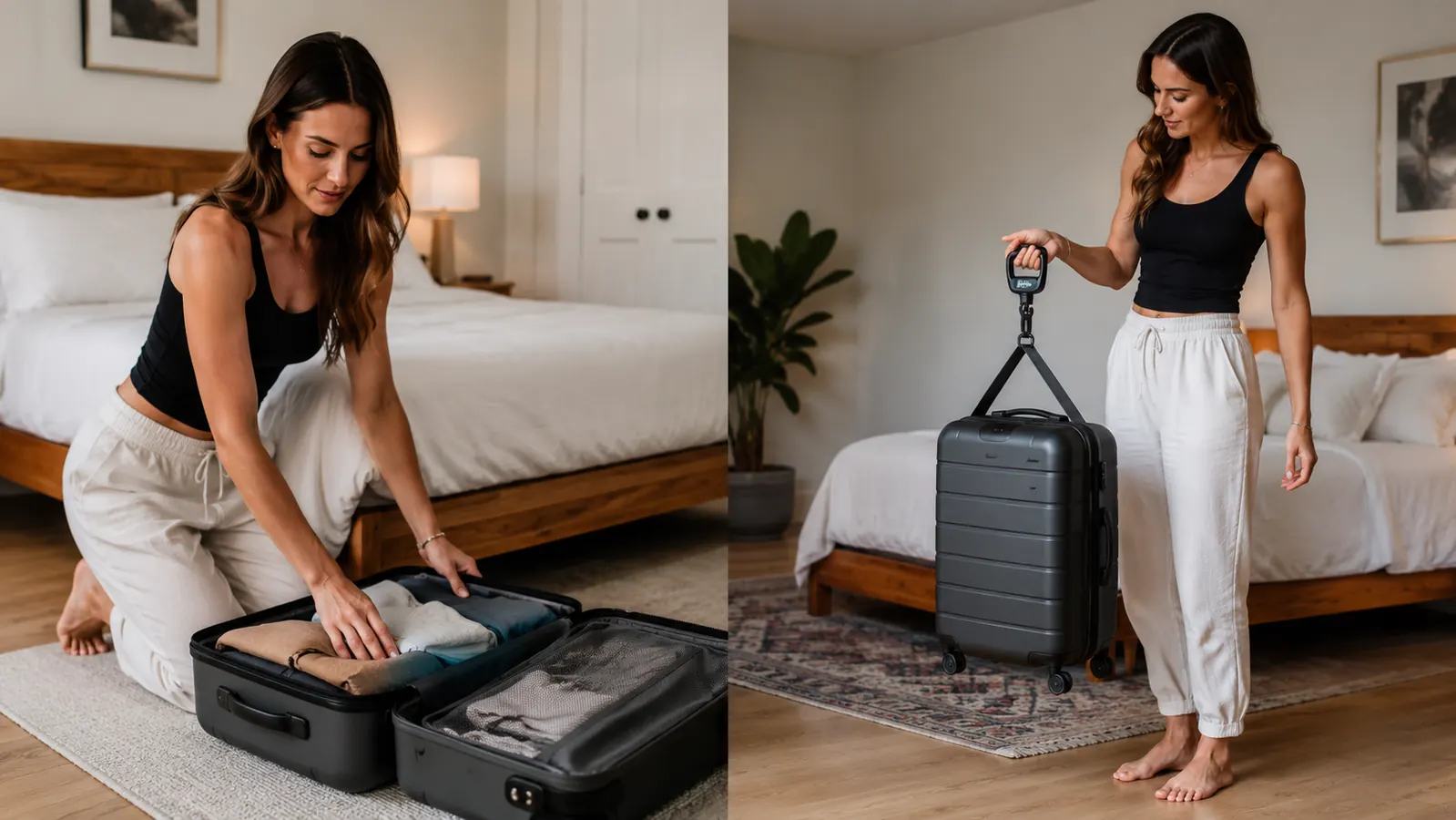
Here is where all the past disappointments came from. The bag was fine on Tuesday, and between then and the flight I tucked in a second pair of shoes, two paperbacks, the growler I planned to bring home, and a heavy charging brick. Nothing felt like a mountain, but a lot of my dumb pounds are built out of small additions. So the final, binding weigh always happens the day before travel, after every add-on, so I sleep on a true number, not on the bag I packed on Tuesday.
This is also the night I make the real choices. If the finished bag is two over, I find the two pounds among the things I do not truly need, a second denim jacket, a book I expect to finish (I never do by the return), the shoes that only work with one dress. Move one whole category into a smaller bag or a tote, and suddenly the bigger bag read shows under. The scale turns the surgical fix from a guess into a check that actually worked.
I hand out the whole day before the flight, because I do not want to discover the problem at five in the running of a forgetful, impossible fix. A calm repack on a quiet evening replaces the panic repack in the airport corridor, and the scale lets me verify before I even leave the drive. Nobody at the desk ever asks what your bag weighs out of curiosity, they ask because they are about to charge you.
Step 5: Run the same check on the return leg, when the bag is heaviest
The return trip is the one that used to betray me. I leave light, all good, and then I come back with gifts, an extra coffee bag, a stone someone gave me, a full new pair of boots. Airlines weigh the return as strictly as the outbound, and they love the surprise of it. So the last night of any trip I set the bag on a hotel bureau, add the souvenirs on top, lift it once on the Etekcity scale, and if the number is too high I redistribute, one thing into my carry personal item, before I ever close the latch.
The carry-on and the personal item are the pressure valve. The checked bag does not carry the weight of every good-bye gift and every purchase; the heavy, solid, and the below you would have lost a checked fee over, can ride in your hand for the short stretch to the plane. A scale lets you divide the weight with your own two hands instead of having a stranger do it at a counter in front of the whole line.
Then I set the number aside and remember why I started this routine in the first place. I was not broke and I was not careless, I was just using my hand instead of a real number. The rule that fixes every trip is the same and unbreakable: know it before you leave, do not find out at the counter. That is the whole system, and it is small enough to take, every time.
What Else Helps
The scale does the heavy truth, but a few quiet neighbors pull their weight alongside it. A set of roll-up cubes squashes the air out of sweaters and denim so the same clothes take less room in the bag. A small digital-luggage scale like the Etekcity, as covered here, is the natural partner to that, because rolling and compressing can pack the same pounds into a smaller, more convenient shell, and knowing that number is the only way to keep the outlier out of the impulse.
The other honest helper is the airline app. Look up the exact allowance for your route and your ticket class before you pack, not the memory of what the limit used to be. Every airline is a little different, and the same trip outbound and return can carry different numbers. Write the limit on the Etekcity scale in your head the minute you book it, the weight to the bag, and let the scale be the second opinion at the door.
The whole point of these pairs is that shopping the weigh is a small slice of peace. I do not want to be the traveler with the sweaty repack in the line, I want to be the one who has already settled it at home. A scale and a short routine are the difference between a trip that starts stressed and a trip that starts calm, and I would rather spend ten minutes with a hinge and a strap than an hour of airport theatrics.
The best fix is the one that happens before you close the lid. So I weigh the empty bag, I aim at the written limit, I pack to a real number, I confirm it the night before with every add-on, and I run the same check on the way home. The Etekcity scale made the whole thing small enough to do every time, and that turns the genuine surprise of check-in into a thing I simply no longer risk.
The check-in employee stopped reading the weight aloud to me, which is not nothing. Once I carried the Etekcity scale and used it the night before, my bag was always under what the airline asked, enough that the whole counter ritual went from a gamble to a formality.
Weigh your next bag before they do
If you check a bag more than once or twice a year, a decent luggage scale pays for itself in the shrink of the very first flight. The Etekcity is a tested, practical place to start, and this whole routine was built around it.
Amazon Check Today's Price on Amazon →